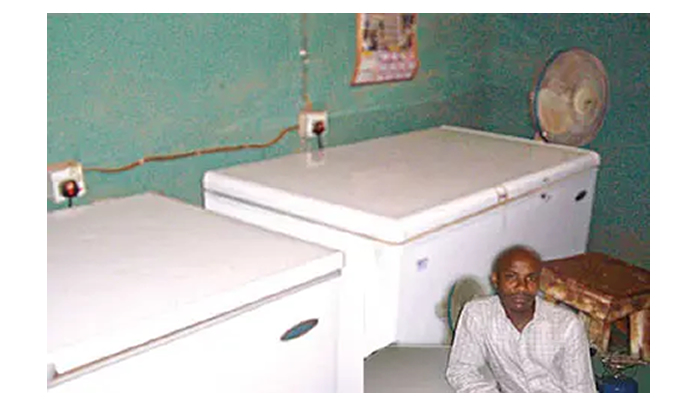
Epileptic power supply: Frozen food sellers now fry, roast chicken, turkey to cut losses
As Nigerians battle to feed in this depressed economy, there is also need to improvise to survive the effect of the economy in their businesses.
Among many of the country’s economic problems is the epileptic power supply.
While households are lamenting “crazy bills” Power Holding Company of Nigeria, PHCN expect them to pay for darkness, businesses are running at losses because with the crazy pump price of diesel and fuel, individual generating of power to sustain businesses is no longer sustainable.
Worse hit, in this category is frozen food sellers. Their businesses depend on steady light. Inadequate electricity supply means they will have to generate power to keep businesses going. But, this also bloats overhead cost and snowball into inflated frozen food prices.
With the economy almost in tatters, common people hardly afford frozen fish, meat and other diaries.
However, Economy&Lifestyle has just discovered that frozen food sellers, who are always left with large volumes of unsold cartons of fish, chicken and turkey, now fry them as constant light to preserve them appear elusive.
This is not withstanding that these dairy products are priced better when fully frozen.
Madam Aliyah Kareem, a frozen food seller in Ikorodu, said she pays N1,000 daily to preserve her unsold goods in a cold room located close to her shop.
She noted that the inconsistent power supply made the cold room owner increase the preservation bill to N2,000, due to the high cost of diesel.
“I couldn’t meet up with such payment per day. How much gain is there in this business?
“The increased cost of frozen foods has brought with it low patronage.
“Most of the chicken, turkey and fish I sell get spoiled if not well frozen.
“So, I thought of frying it by adding little spices and salt to keep it fresh.
“My customers were happy with the innovation and want more for the fried chicken and turkey than the iced ones.”
Mrs. Agnes Salako, a frozen food seller at Agbara market said: “The way this country is going is very bad.
“Imagine doing a business such as ours without electricity.
“Most of my goods got bad a few weeks ago when our electricity was interrupted for over a week.
“I powered my fridge with my generator set but the little fuel couldn’t serve for long.
“When I discovered that the products were going bad, I had to bring out the turkey and chicken and roasted them.
“I thought I would not make sales, but I was shocked to see people buying it.
“A customer said I have saved her the cost of buying vegetable oil coupled with gas for frying it” she added.
Mr. Menshack Bassey, a customer, said he prefers the smoked chicken to the frozen one because it saves him the time for frying.
“ I don’t have enough time to cook because of the nature of my business. The day I saw Madam Salako selling smoked chicken and other dairy products, I was very happy.
“If I buy the chicken as it is, my meal is made in just few minutes, contrary to when I will have to wash the chicken parboil or fry and then use to cook”
According to the Central Bank of Nigeria, CBN, third quarter 2023 (Q3’23) Economic Report, the average electricity generated fell quarter-on-quarter to 3,895.76 Megawatts per hour(MW/h).
“The estimated average electricity generation in Q3’ 23 at 3,895.76 MW/h, decreased by 4.1 per cent from 4,058.93 MW/h in the preceding quarter.”
In its Q3’ 23 report, the National Electricity Regulatory Commission (NERC), said that the national power grid (designed for stability at voltage: 330kV ± 5.0% and frequency: 50Hz ± 0.5%) faces risks of outages due to deviations. High demand lowers frequency, causing automatic plant shutdowns, while excess supply raises frequency, potentially triggering sudden drops in generation.
In Q3’ 23 alone, Nigeria recorded two (2) episodes of national grid collapse after three(3) consecutive quarters of no incidence of system collapse from Q4’22 to Q2’ 23.
Recently, the Minister of Power,Mr. Adebayo Adelabu hinted at the government’s proposed unbundling of the Transmission Company of Nigeria (TCN) into two different entities, the Independent System Operator and the Transmission Service Provider, to align with the Electricity Act 2023 and the industry’s demands.
Source: Punch